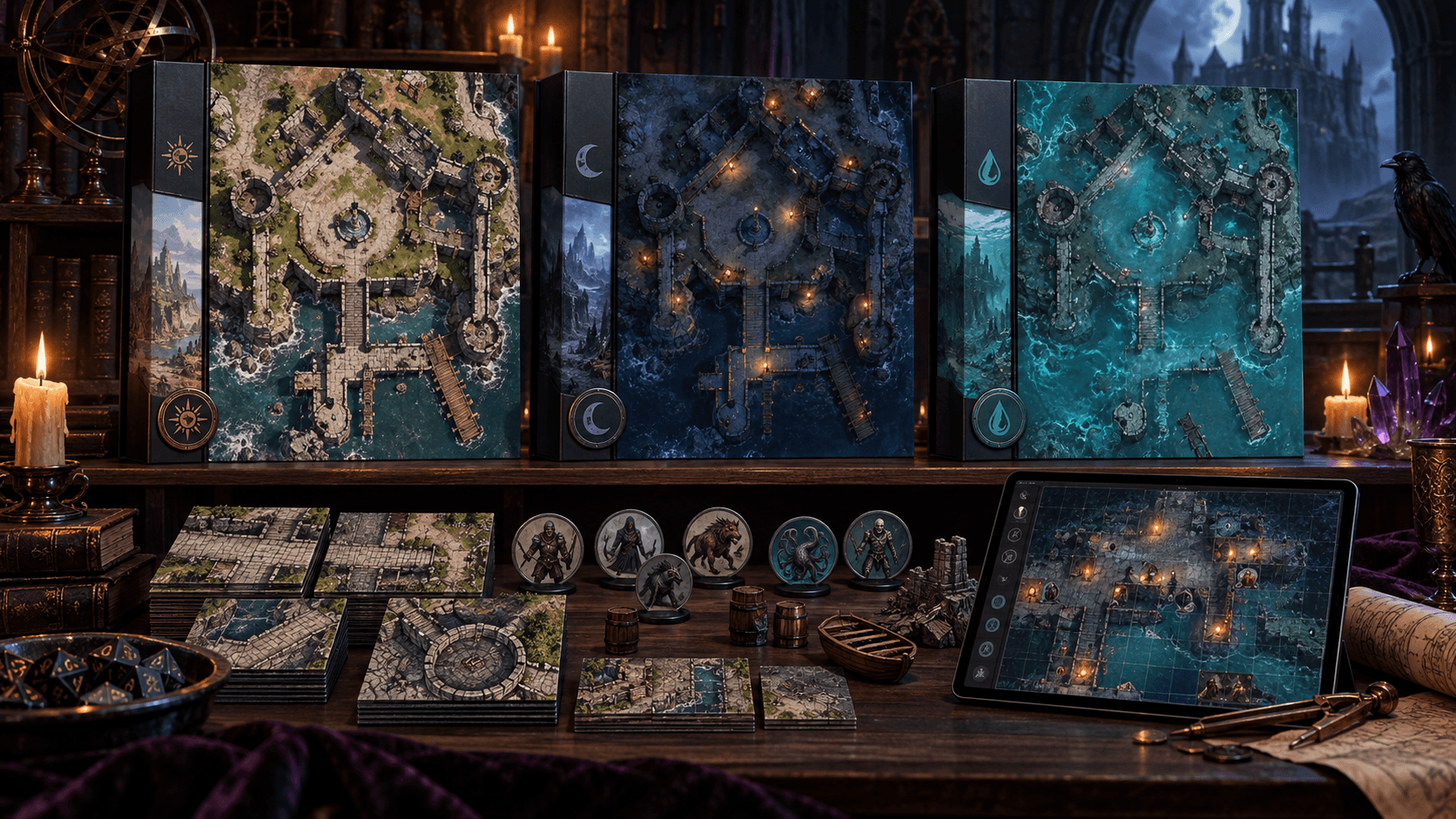
Best Battle Map Pack Subscriptions in 2026: Czepeku, Forgotten Adventures, Tom Cartos and the Alternatives
An honest comparison of battle map subscription models, formats, variants, licensing and VTT support from Czepeku, Forgotten Adventures, Tom Cartos and custom workflows.
Battle map subscriptions compete on more than art quality. They compete on how many useful situations a GM can cover, how fast a map reaches the table, whether variants are included, and what the license permits after the session. A huge archive is valuable only if you can find the right scene and use it in the way you intend.
This comparison focuses on the product models, not on declaring one artist the winner. Czepeku is unusually strong at volume, variants and VTT-ready delivery. Forgotten Adventures is strong when you want a reusable asset ecosystem and versatile mapmaking. Tom Cartos combines maps, assets, tokens and direct storefront options. A custom generation workflow is strongest when the encounter is specific enough that a library is unlikely to have it.
Quick comparison
| Provider or approach | Best for | What stands out | Tradeoff |
|---|---|---|---|
| Czepeku | Large fantasy archive and many variants | Weekly map packs, multiple tiers, VTT modules and a large back catalogue | License details differ by use; commercial redistribution needs care |
| Forgotten Adventures | Versatile fantasy maps and reusable art ecosystem | Map releases plus a broad asset library and overlay tiles | Best results assume comfort with the FA visual ecosystem |
| Tom Cartos | Maps, assets, tokens and adventure-oriented content | Patreon, direct shop and listings across several VTT ecosystems | Catalog navigation and license choice need attention |
| One-off marketplace purchase | A single encounter or campaign need | No ongoing subscription | Less predictable style and fewer future variants |
| Generate on demand | Specific location, theme or campaign bible | Custom brief and controlled companion assets | You must validate grid, walls, lighting and final quality |
Czepeku: the benchmark for recurring content
Czepeku's current Patreon page describes weekly map packs, multiple tiers, a large archive and different rewards for base maps, variations, animated maps and Foundry modules. At the time of writing, the page displays 16,565 paid members and an average of 10 maps per release, while also noting that some releases contain more. Those numbers are useful context, not a promise that every release has the same volume.
Czepeku's strength is reducing the number of decisions a GM has to make. The weakness is that a library cannot anticipate every campaign's exact room, culture, camera or mechanical need. The commercial license also deserves careful reading: the official license page distinguishes streaming, published products, paid games, attribution and redistribution. Do not treat “I can use this at my table” as “I can ship this inside my own asset pack.”
Forgotten Adventures: versatility over one-off spectacle
Forgotten Adventures describes its battle map focus as versatile content that can fit many campaigns, with occasional specific locations and overlay tiles. That is a different value proposition from a cinematic map library. It is useful when you want to remix an encounter, change a section of a room or build a scene around a consistent asset language.
The tradeoff is aesthetic commitment. If you want a map to feel unlike every other map in the same library, you may need to edit, overlay or generate additional assets. A strong library gives you reusable ingredients. It does not guarantee a unique campaign identity.
Tom Cartos: a broader catalog and more purchase paths
Tom Cartos covers battle maps, assets, tokens and adventures, and the official site points to Patreon, a direct shop and several VTT marketplaces. That makes the catalog useful for GMs who want to buy a specific pack rather than maintain a single subscription.
His FAQ also makes an important licensing point: map dimensions are included in pack filenames, and publishers should ask about availability rather than assume a personal subscription covers commercial publishing. This is a good habit for every marketplace: confirm the use case before you download the asset.
Variants are the real multiplier
| Variant | Gameplay use | Why it matters |
|---|---|---|
| Day and night | Different encounter beats | Reuse the same geography without repeating the exact mood |
| Empty and dressed | Exploration versus combat | Lets tokens and gameplay props remain readable |
| Fire, flood or damage | Escalation during a scene | Makes the map communicate a state change |
| Grid and gridless | Different table systems | Reduces import work in the VTT or virtual tabletop |
| VTT module and flat image | Fast setup versus portability | Matches the group's preferred amount of automation |
Subscription or custom generation?
Subscribe when your campaign benefits from a deep archive, you enjoy browsing and you want new maps every month. Buy once when you need one specific encounter. Generate when the location is central to the story, the visual identity matters or the map needs companion tokens, effects and audio in one style.
Sprixen's battle map generator is not a replacement for Czepeku's archive. It is a way to explore a custom brief and produce supporting assets when a stock map is close but not close enough. The sensible workflow is often hybrid: use a library for generic locations and generate only the memorable, campaign-specific pieces.
Make game art that stays in one style.
Generate sprites, animations, tiles and effects that share one locked style per project, in the web app or straight from Claude Code and Cursor. 6 free credits on signup, no credit card required.
Related Articles
Best AI Game Asset Generators in 2026: Sprites, Icons, Tiles, UI and 3D
The AI game asset generators worth using in 2026, compared on what they make (sprites, icons, tiles, UI, 3D), price, free tier, API and MCP access, with results from a real test session.
Best AI Sprite Animation Generators in 2026 (Walk Cycles, Attacks, 8 Directions)
AI sprite animation generators compared: how each one animates (text, image, skeleton, video, 3D), frame counts, directions, export formats and price per animation, plus a real 4 and 8 direction test.
Best MCP Servers for Game Development in 2026 (Godot, Unity, Unreal, Blender, Roblox)
The MCP servers that let Claude Code, Codex and Cursor work inside game engines and generate game assets: Godot, Unity, Unreal, Blender, Roblox Studio, Aseprite and asset generators, with stars and install commands.