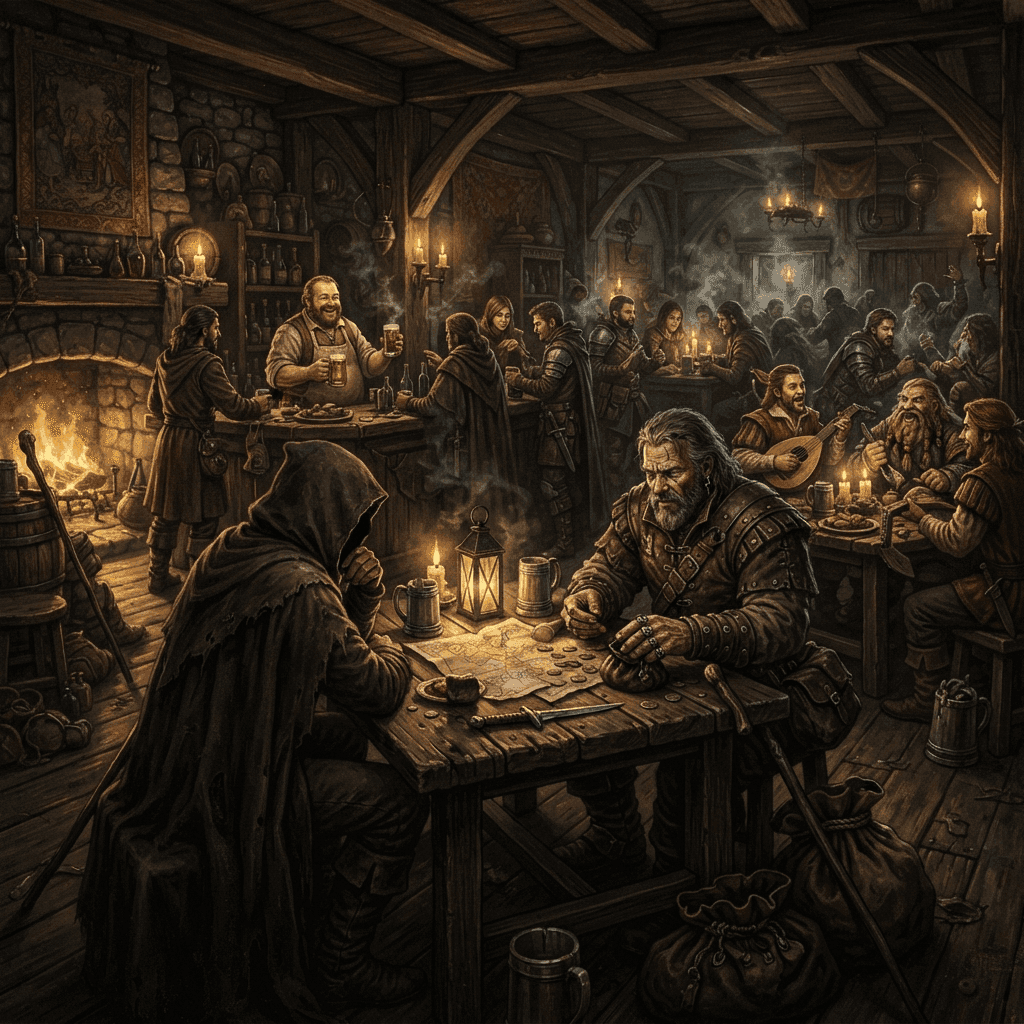
Best D&D NPC Generators in 2026 (Names, Personalities, Stat Blocks and Art)
Kassoon, donjon, Eigengrau's Generator, Chartopia, Foundry NPC modules and Sprixen's free NPC generator compared for building a usable tavern-keeper or villain in minutes.
Every DM eventually needs a name, a face and a personality for someone the players weren't supposed to talk to. A good NPC generator saves that improvisation without making the character feel like it came from a random table, which, honestly, it often did. We compared the main free NPC generators on what they actually output: a name, a full mechanical stat block, read-aloud prose, or portrait art, since very few tools do all four well.
TL;DR: Kassoon gives you a mechanically clean, 5e-shaped NPC fast. donjon generates them in batches with a sentence of motivation. Eigengrau's Generator writes actual read-aloud prose instead of bullet points. Chartopia is a platform of community-built tables rather than one fixed generator. Foundry's package browser has several free NPC modules if you want the output to land directly in your world. Sprixen's free NPC generator is the option built for output that goes straight onto a VTT: a name, personality, portrait and token, exported as a Foundry Actor JSON file.
Quick Comparison Table
| Tool | Price | Output | Portrait art | VTT-ready export |
|---|---|---|---|---|
| Kassoon NPC Generator | Free, no signup | Name, race, class, personality, optional stat block | No | No |
| donjon | Free | Batches of NPCs with stats, alignment, description, motivation | No | No |
| Eigengrau's Generator | Free, open source | Read-aloud prose paragraphs, town and NPC context | No | No |
| Chartopia | Free (optional Patreon) | Whatever the community table you pick outputs | Rarely | No |
| Foundry NPC modules | Free and paid modules in the package browser | Varies by module; several generate a usable Actor directly | No, still needs separate art | Yes, lands directly in your Foundry world |
| Sprixen | Free tool | Name, personality, light stat block | Yes, AI-generated portrait and token | Yes, Foundry Actor JSON with portrait and token attached |
1. Kassoon
Kassoon is a long-running, free, no-signup collection of D&D 5e tools, and its NPC Generator produces a quick, 5e-shaped profile: name, race, class and personality traits, with an optional stat block if you need the NPC to actually fight. The output is short and mechanical rather than narrative, built for the table, not for a written adventure module. It sits alongside Kassoon's other free tools (a town generator, an encounter builder, a dungeon map generator) if you need more than one NPC at once.
Strengths: fast, 5e-conformant, free, no account.
Weaknesses: no portrait, output is bare-bones enough that you'll still improvise most of the personality yourself.
Best for: a DM who just needs a quick mechanical skeleton and will supply the roleplay themselves.
2. donjon
donjon is one of the oldest and most comprehensive free generator sites in the d20 space, covering everything from dungeons to treasure to NPCs. Its NPC generator lets you set gender, race, class and culture, then produces a batch (commonly ten at a time) of NPCs, each with a name, alignment, base stats, a brief physical description and a one-sentence motivation.
Strengths: generates in batches, which is useful for stocking a whole town at once, free, no signup.
Weaknesses: older interface, output leans mechanical over narrative, no art.
Best for: stocking a market square or a guard barracks with several NPCs at once rather than crafting one important character.
3. Eigengrau's Generator
Eigengrau's Generator takes a different approach from the two above: it's free, open source (MIT licensed), and generates full paragraphs of text meant to be read directly to players, not bullet points meant to be interpreted. It started as a tavern generator and grew to include NPCs, shops, factions and temples, with much of its underlying random-table content sourced from the r/behindTheTables community.
Strengths: genuinely read-aloud prose quality, open source, free, covers more than just NPCs.
Weaknesses: the prose style won't fit every table's tone, no mechanical stat block, no art.
Best for: a DM who wants to read a paragraph aloud and have it sound like prepared narration, not a random table result.
4. Chartopia
Chartopia is a platform where the community builds, shares and browses random tables and generators, funded by an optional Patreon, rather than one fixed generator. That means NPC quality and depth vary wildly depending on which user-made table you pick; some are single-line name tables, others are elaborate multi-branch generators.
Strengths: huge breadth if you're willing to search, free to use.
Weaknesses: inconsistent quality since anyone can publish a table, requires more browsing than the single-purpose tools above.
Best for: a DM who enjoys browsing community content and wants something more specific than a generic NPC generator provides.
5. Foundry NPC modules
Foundry's package browser hosts several dedicated NPC generation modules, ranging from simple name randomizers to more complete tools like a "Generate 5e NPC" button that builds an Actor from a chosen level range, race and class. Because these run inside Foundry itself, the result lands directly in your world as an Actor you can drop onto the map, no copy-pasting a name and stats from an external website.
Strengths: output lands directly in your Foundry world, several free options exist, no context-switching to a browser tab mid-session.
Weaknesses: quality and feature depth vary a lot between modules, none of the ones we found generate portrait art alongside the Actor.
Best for: Foundry users who want the NPC to already exist as a droppable Actor rather than a block of text to retype.
6. Sprixen NPC Generator
Sprixen's free D&D NPC generator is built for the same problem the Foundry modules solve, getting a usable, droppable NPC, but adds the piece none of the tools above cover: a matching AI-generated portrait and token in the same pass. Describe what you need ("a suspicious dockside merchant," "a retired paladin running a tavern") and it returns a name, personality, a light stat block, a portrait and a token together, exported as a Foundry Actor JSON file you can import directly.
Strengths: portrait and token generated with the NPC instead of sourced separately, direct Foundry Actor JSON export, free.
Weaknesses: the stat block is lighter than a hand-built 5e statblock from D&D Beyond's homebrew tool, better suited to a face NPC than a boss monster. For a boss-level creature with a full CR-aware stat block, see best D&D monster makers in 2026.
Best for: a DM who wants a complete, ready-to-drop NPC, including the face players will actually see, generated in one step instead of stitched together from three tools.
How to Choose
- Need ten background NPCs fast: donjon or Kassoon.
- Need a paragraph you can read aloud right now: Eigengrau's Generator.
- Already living in Foundry and want the Actor to just appear: a Foundry NPC module.
- Need the NPC to have a face and be ready to drop onto a VTT: Sprixen's NPC generator.
Making a Generated NPC Feel Real
A generator gets you unstuck fast, but a name and a race alone won't carry a scene once the players start asking follow-up questions. A few habits turn a random result into an NPC that feels like it was always part of the world.
- Give them one want and one obstacle. A tavern keeper who wants her missing brother found and is being pressured by a loan shark is a character. A tavern keeper with just a name and a race is furniture, and neither Kassoon nor donjon writes that obstacle for you; that part still comes from the DM.
- Pick a single verbal tic, not five. A generated personality trait list can be long. Play one of them consistently (always answers a question with another question, never makes eye contact, talks about the weather constantly) rather than trying to perform all of them at once.
- Decide what they know that the party doesn't. Even a background NPC is more useful if they're holding one piece of information, a rumor, a name, a warning, that might matter later. It costs nothing to write and gives you a hook if the scene needs one.
- Reuse them. The generator produced a batch of ten NPCs for the market square; you don't need all ten to matter, but the one the party actually talked to should show up again. A recurring background character does more for immersion than three new one-off names next session.
Keep a running note, even a short one, of which generated NPCs the party has actually met and what happened in that scene. It takes thirty seconds after a session and saves you from accidentally reintroducing "the suspicious dockside merchant" as a brand-new character three sessions later because the original name got lost in a pile of generator output. A plain text file with one line per NPC works fine; the tool doesn't matter here nearly as much as the habit of writing it down at all.
Stocking a Whole Location at Once
Individual NPC generators like Kassoon and Sprixen's tool are built for one character at a time, which is exactly right when you need a specific face for a specific scene. For stocking an entire town, market or dungeon faction before a session, a batch generator saves real prep time: donjon's ten-at-a-time output, or Kassoon's Town Generator, gets you a full cast of shopkeepers, guards and locals to draw from without hand-rolling each one. Save the single-NPC tools, including Sprixen's, for the handful of characters you already know will matter, the questgiver, the recurring rival, the informant, where a portrait and a token are worth the extra step.
FAQ
What's the best free D&D NPC generator?
It depends what you need. Kassoon and donjon are fastest for a mechanical skeleton. Eigengrau's Generator is best for read-aloud prose. Sprixen's is the option that also produces a portrait and token in the same step.
Do any NPC generators include portrait art?
Most classic random-table generators (Kassoon, donjon, Eigengrau's, Chartopia) don't. Sprixen's NPC generator does, since it generates the portrait and token alongside the name and personality.
Can I import a generated NPC directly into Foundry?
Foundry's own NPC modules build the Actor directly in your world. Sprixen's NPC generator exports a Foundry Actor JSON file with portrait and token attached that you can import the same way.
What's the difference between an NPC generator and a monster maker?
An NPC generator is usually built for a talking, non-combat-focused character (a shopkeeper, a noble, a guard). A monster maker is built for a full combat stat block with a challenge rating. See best D&D monster makers in 2026 for the combat side.
Is Sprixen's NPC generator only for D&D 5e?
It produces a light, 5e-style stat block that works fine for most home games and is easy to adapt to other systems, but it isn't a rules-accurate 5e statblock generator the way D&D Beyond's homebrew tool aims to be.
How many NPC generators does a DM actually need?
Fewer than the number available might suggest. A batch generator like donjon or Kassoon for stocking a location, and a portrait-and-token tool like Sprixen's for the handful of NPCs who become recurring, covers most tables. Bouncing between five different generator sites usually costs more prep time than it saves.
For a session where the NPCs need a stage too, Sprixen Drops ships a full themed VTT pack, maps, tokens, VFX and audio, every month.
Skip the prep. Grab this month's drop.
The Sunken Harbor drop ships 5 battle maps with day and night variants, 20 tokens, 6 animated effects and 3 ambient loops, all in one style, plus a free sample map to try before you sign up.
Related Articles
7 Best D&D Map Makers in 2026 (Battle Maps and Dungeons Compared)
Dungeon Alchemist, Inkarnate, Dungeondraft, Dungeon Scrawl, Wonderdraft, Arkenforge and Sprixen's free battle map generator compared on price, map type, VTT export and learning curve.
8 Best D&D Token Makers in 2026 (Free and VTT-Ready)
Token Stamp 2, Foundry's built-in token tools, Roll20, GM Craft Tavern, Hero Forge and Sprixen's free token maker compared, plus the exact token sizes each VTT expects.
Best D&D Monster Makers and Homebrew Stat Block Tools in 2026
Tetra-cube's statblock generator, D&D Beyond homebrew, GM Binder, Homebrewery, Kobold Fight Club and Sprixen's free monster maker compared for building and balancing a homebrew creature.