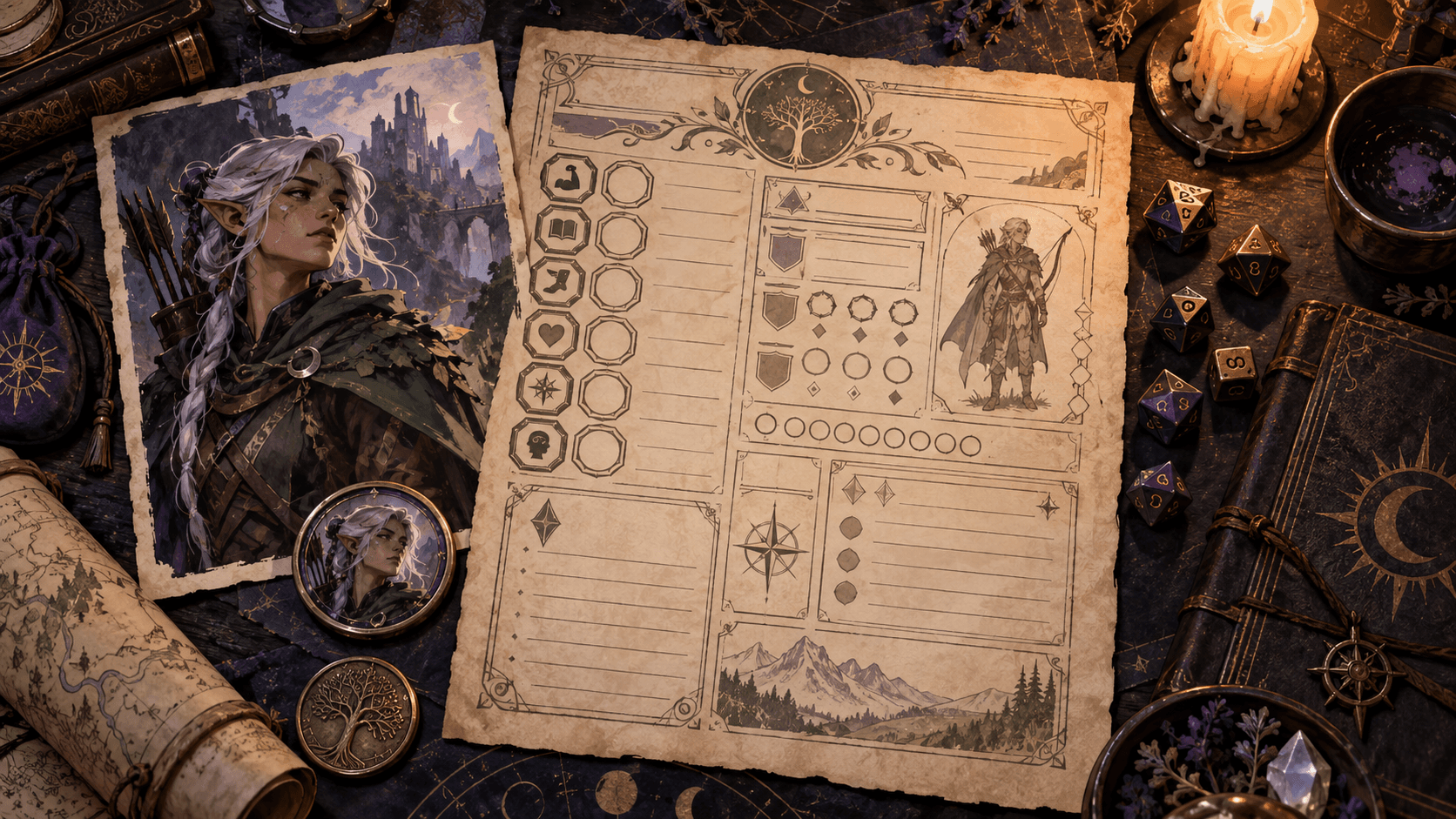
The D&D 5e Character Sheet Explained: Every Box, and What to Fill First
A beginner-friendly D&D 5e character sheet guide that explains the dependency order from concept and class to modifiers, proficiency, combat and personality.
A D&D character sheet looks like a form, but it is really a map of dependencies. Your class affects features and proficiencies. Your ability scores affect modifiers. Modifiers and proficiency affect skills, attacks and spellcasting. If you fill the boxes in visual order, you often have to rewrite them later.
This guide explains the common 5e sheet in the order that makes the numbers easiest to verify. D&D has both 2014 and 2024 rules content in circulation, so use the sheet and rules version your table agreed on. The official D&D Beyond character sheet resources provide current official sheet options.
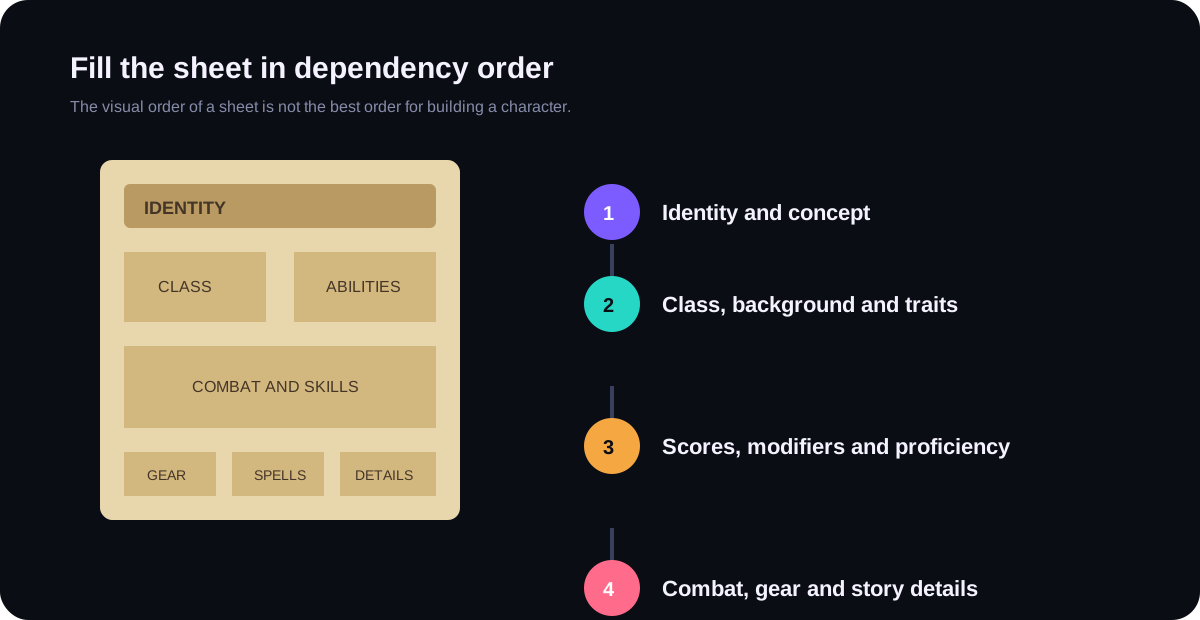
Fill the sheet in dependency order
| Step | Fill | Why now | Check |
|---|---|---|---|
| 1 | Name, concept, species or ancestry and background | Creates the character you are actually building | Can you describe the character in one sentence? |
| 2 | Class, level and class features | Determines core proficiencies and abilities | Use the class rules for the same edition as the sheet |
| 3 | Ability scores and modifiers | Modifiers feed most of the numbers below | Apply the official score-to-modifier table |
| 4 | Proficiency bonus and proficiencies | Adds training where the rules allow it | Never add proficiency twice to the same roll |
| 5 | HP, AC, initiative, speed, attacks and spells | These are derived from the previous choices | Check equipment and class formulas |
| 6 | Personality, ideals, bonds, flaws and appearance | Makes the mechanics playable as a person | Write hooks the table can use, not a biography nobody remembers |
Ability scores become modifiers
In the 2024 Basic Rules, the ability modifier is derived from the score. The official table includes scores from 1 through 30, with 10 and 11 producing +0, 12 and 13 producing +1, and each pair of higher scores increasing the modifier by one. The exact table is in D&D Beyond's character creation rules.
Write both the score and the modifier. Players usually roll with the modifier, while the score remains important for later increases and rule checks. If a feat or feature changes a score to an even number, the modifier may change too, which can update several boxes at once.
Proficiency is training, not a universal bonus
Your proficiency bonus is based on total character level, not a single class level. You add it when the rules say you are proficient with the relevant skill, saving throw, weapon or spell attack. You do not add it twice because two different features sound related. The 2024 rules explain that the bonus is applied once to a qualifying D20 Test.
| Sheet area | Typical formula | What to verify |
|---|---|---|
| Ability check | d20 + relevant ability modifier, plus proficiency if relevant | Whether the skill or tool proficiency applies |
| Saving throw | d20 + ability modifier, plus proficiency if proficient | Which saves the class grants |
| Weapon attack | d20 + attack ability modifier, plus proficiency if proficient | Weapon property and class proficiency |
| Spell save DC | 8 + spellcasting ability modifier + proficiency bonus | The class's spellcasting ability |
| Spell attack | spellcasting ability modifier + proficiency bonus | Do not use the wrong ability for a multiclass |
What to fill next
Once the class and scores are fixed, fill hit points, armor class, initiative, speed, attacks, spellcasting and equipment. These boxes are where a character sheet becomes useful during play. If a number is derived, write the formula in a note while learning. You can remove the note once the table is comfortable with it.
Portrait and token are different jobs
A portrait helps the table remember the character between scenes. A token communicates position, scale and ownership during play. They can share the same face, palette and costume, but the crop should be different. Use a readable bust or three-quarter portrait for the sheet and a high-contrast silhouette or circular crop for the token.
Sprixen's character portrait generator is useful for exploring a consistent visual identity, while the token should be tested at the actual VTT size. A beautiful portrait with a low-contrast token is still a weak table asset.
Five first-session errors
- Using a 2014 sheet with 2024 rules without checking the differences.
- Writing the ability score but forgetting the modifier.
- Adding proficiency to every skill instead of only proficient skills.
- Calculating AC from a remembered formula that does not match the class, armor or feature.
- Writing personality details that cannot create a decision, relationship or scene.
A character sheet is successful when it reduces table friction. Fill the dependencies first, verify the derived numbers, then give the character a visual identity that the group can recognize quickly.
Ready to try Sprixen?
Generate consistent, style-locked assets for your game. 6 free credits on signup, no credit card required.
Get Started FreeRelated Articles
Roblox 2D Asset Sizes in 2026: Icon, Thumbnail, UI, Clothing and Particle Cheat Sheet
A practical Roblox 2D asset reference covering discovery images, UI, classic clothing, layered textures, decals and particle flipbooks, with the mistakes that cause rework.
Roblox UI Kit Guide: 9-Slice, Scale Types and a Style That Holds Together
How to build Roblox UI art that survives different screen sizes using 9-slice, UIScale, constraints, readable states and a shared visual system.
Roblox Particle Textures and VFX Flipbooks: Sizes, Alpha and the Mistakes That Kill Performance
A practical guide to Roblox ParticleEmitter textures and flipbooks, including grid layouts, alpha, mobile profiling and a safe export workflow.