
How to Mod Games with AI Agents: A 2026 Guide for Claude Code and Codex
How to mod games with AI agents in 2026: what changed, the universal-modder workflow in Claude Code, art that matches the original game, and the legal lines to respect.
To mod a game with an AI agent, give the agent three things: a toolkit that teaches it to identify the engine, read the real code and test inside the running game; a source of art that matches the game's sizes, palette and sheet layout; and clear limits on what you publish. In 2026 the common setup is Claude Code, Codex or Cursor with the open source universal-modder skills, a game you own, and an asset generator the agent can call over MCP.
What changed in 2026
Agents got good enough at reading and rewriting game code that modding stopped being a niche skill. Naavik's October 13 analysis counted 7.4 million views on a clip that added skateboarding to Modern Warfare and 23.3 million on a mod that turned Minecraft into Elden Ring, and it names Claude Opus 5.5 as the model mash-up creators most often say they rely on. It describes three techniques:
- Pass-through mods that run two games at once, with a live interpreter watching one and telling the other what to do.
- Porting a mechanic, such as parkour or vehicle physics, from one game into another.
- Full decompilation and recompilation of a game into a replacement codebase.
Publishers answered just as fast. Kotaku reported on October 3 that Activision had footage of a generative AI decompilation of the original Modern Warfare 2, built with 17 agents working in parallel, disabled with a copyright notice, and that the creator of a browser recreation called Fallout: New York dropped it after an alleged cease-and-desist from Bethesda. Mod hosts adjusted too: in July, Nexus Mods split its AI disclosure into three tags (AI-Generated Content, AI Media and AI Assisted) and now moderates mods that are tagged wrong.
The tooling settled around open skill kits. universal-modder, MIT licensed, had close to 9,000 GitHub stars on October 25, 2026, and installs into Claude Code, Codex, Gemini CLI, Copilot, Cursor and OpenCode. For original games, Claude-Code-Game-Studios turns Claude Code into a studio of 49 specialist agents.
The workflow with Claude Code and universal-modder
Install the plugin from inside Claude Code:
/plugin marketplace add rehan-remade/universal-modder
/plugin install universal-modder@universal-modder
Its main skill, mod-any-game, runs the same loop every time. The project's README lists it in this order:
- Search the knowledge base of field notes for prior work on the game.
- Recon the install (engine, version, managed or native code), then pick a route.
- Set up a safe lab with saves backed up.
- Read the actual code.
- Build one working slice.
- Generate the assets.
- Verify in the real game.
- Record it.
- Package the mod.
- Write a field note for the next agent.
Separate skills cover the steps: game-recon, reverse-engineering, asset-pipeline, game-automation (launching and driving the game so the agent can test its own work), publish-mod, port-a-mod, mashup-mods and showcase-video. Two habits make sessions go well. Start with a game that has an official mod loader, such as Terraria with tModLoader, Stardew Valley with SMAPI and Content Patcher, or Minecraft with resource packs and add-ons, so the agent spends its time on your idea instead of on injecting code. And ask for one slice first, for example one new item that drops, shows its sprite and works, before the full set.
Mod Terraria with tModLoader: add an ember greatsword and an ash crawler enemy that drops it.
Recon first, then build only the sword. Make the art in my Sprixen project "Ember Mod" at
Terraria's sizes, and show me the sprite in game before you start the enemy.
Where the art comes from
Code is the part agents now handle well. Art is where most AI mods still look wrong: sprites at the wrong size, colors from a different game, animation strips in a layout the engine cannot read. Treat the original game's art as a spec.
- Take sizes from the game's own examples. Terraria's ExampleMod sword is 40x40, Stardew Valley items are 16x16 with NPC frames of 16x32 and portraits of 64x64, and default Minecraft textures are 16x16. Generate at a clean multiple and downscale with nearest neighbor once.
- Match the palette. Take a screenshot of the area your content belongs to and use it as the style reference of your Sprixen project; the palette, texel density and filter then follow the game. We show how one reference becomes those rules in one art style across 2D and 3D. The output is new art, so never feed the game's textures in to be copied.
- Match the sheet layout. Terraria stacks NPC frames in one vertical column, Stardew NPC sheets use rows of four 16x32 frames with one row per direction, and many engines want a horizontal strip with a JSON atlas. universal-modder's asset-pipeline skill handles cutout, trimming, nearest-neighbour fitting, pixelation to a palette and sheet assembly.
- For 3D games, think in meters. A prop for a 3D game needs a real size, a pivot on the floor and a texture budget the engine can stream. Sprixen's 3D engine exports GLB in meters, and auto rig gives creatures a Mixamo-named skeleton with in-place clips.
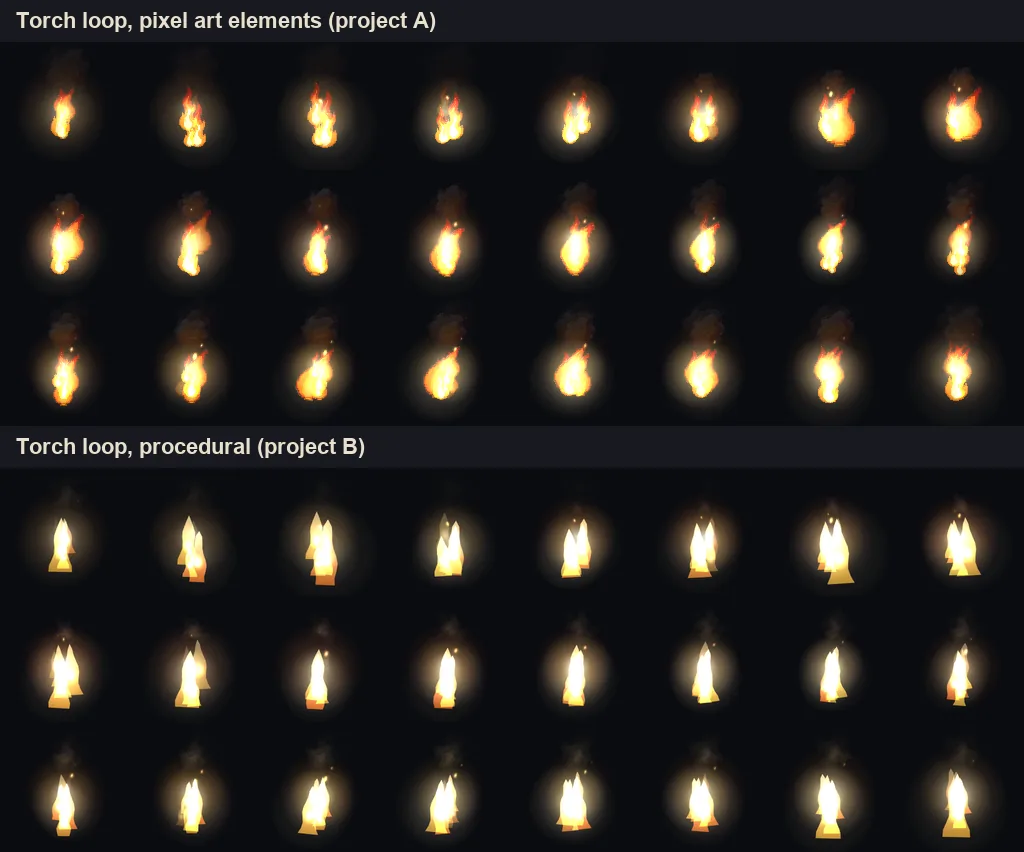
Effects follow the same rule. The two torch loops above come from the same request in two projects with different styles: one built from pixel art fire elements, one procedural. Both export as sprite sheets an engine can slice. Sprixen plugs into the modding loop in two ways: universal-modder ships a um sprixen command, merged on October 18, 2026, for sprites, animation sheets and tiles, and any MCP client can call the same generators directly.
Legal and license notes in plain words
This is a planning summary; for a commercial project, ask a lawyer.
- Mod games you own, and ship only your own work. universal-modder's contribution rules ban game files and decompiled dumps, and its publish-mod skill lints a release for game files, decompiled code and leaked keys before packaging.
- Reverse engineering and distribution are separate questions. Naavik points to Sega v. Accolade and Sony v. Connectix, where some reverse engineering was found to be fair use. That protection does not extend to distributing or selling a reconstructed game, and most license agreements forbid reverse engineering outright.
- Expect takedowns on high-profile projects. The Modern Warfare 2 decompilation and Fallout: New York were both stopped within days of going viral.
- Official mod support is the safe lane. Games with loaders, workshops or documented modding APIs have already said yes to mods.
- Use only art you have rights to. Art you generated is yours to ship under the tool's terms. For 3D library models, CC0 needs nothing and CC-BY needs a credit line; skip NC (no commercial use), SA (your work must carry the same license) and GPL assets.
- Disclose AI where the host asks. On Nexus Mods, generated in-game assets go under AI-Generated Content, and AI used only for promotional images goes under AI Media.
How Sprixen's MCP fits
Sprixen's MCP server gives the agent the art side of the loop and the modding skills themselves:
- One project per mod. Every sprite, animation sheet, tile, effect and 3D model the agent creates in that project shares one style.
- A free game-dev skills catalog. The tools search_game_dev_skills, get_game_dev_skill, get_game_dev_skill_files and get_game_dev_kit, plus the prompts mod-a-game and start-game-studio, serve universal-modder (12 skills and about 290 field notes) and Claude-Code-Game-Studios (49 agents and 74 skills in the version we serve). In our copy of universal-modder, the asset skill calls Sprixen. The catalog costs no credits.
- Jobs the agent can poll. Generations return an ID, so the agent submits once and checks back instead of resubmitting.
To connect it, create an API key and register the server:
claude mcp add --transport http sprixen https://api.sprixen.com/v1/mcp \
  --header "Authorization: Bearer spx_live_YOUR_KEY"
The full tool list and the setup for Codex, Cursor and other clients are in the Sprixen MCP docs.
FAQ
Can AI agents mod any game?
Many, with different effort. Games on managed code, such as Unity titles with Mono or .NET and XNA games like Terraria and Stardew Valley, are the easiest; native engines need reverse engineering; multiplayer games with anti-cheat are a bad idea and usually break the terms of service.
Is it legal to mod games with AI?
Modding a game you own for personal use is widely tolerated and often officially supported. Takedowns target distributing game files, decompiled code or other people's art, so read the game's license and the mod host's rules before you publish.
What sprite size should my mod use?
The size the game already uses for the same kind of content. Open an official example or a vanilla file from your own install, measure it, and generate at that size or a clean multiple of it.
Do I need to disclose AI art in a mod?
On Nexus Mods, yes: in-game assets made with generative AI take the AI-Generated Content tag, and wrong tags lead to moderation. Other hosts and Steam Workshop pages set their own rules, so check where you publish.
Does Sprixen's game-dev skills catalog cost credits?
No. Searching, reading and downloading the skill kits is free; credits apply only when the agent generates assets.
Wire Sprixen into your agent.
The Sprixen MCP server lets Claude Code, Cursor and other agents generate sprites, animations, 3D models and VFX without leaving the chat.
Related Articles
Modding PC Games with Claude Code: Give Your Agent Consistent Sprites
Use universal-modder and Claude Code to mod games you own, and add the Sprixen MCP server so the agent gets one-style sprites and animation sheets.
MCP Game Asset Pipelines: What Claude Code and Cursor Can Actually Automate
A grounded guide to MCP for game asset workflows: what an agent can safely automate, where approvals belong, and how to connect generation, validation and export.
How to Generate Game Sprites from Claude Code with MCP (Step by Step)
A complete walkthrough for generating style-consistent game sprites and animations from Claude Code using Sprixen's MCP server, from API key to exported Phaser package.