Free Dungeon Generators Compared: Random Tables, 3D Layouts and AI Maps
A practical comparison of free dungeon generation approaches, from Dungeon Scrawl and Donjon to Dungeon Alchemist and AI-assisted map tools.
“Free dungeon generator” can mean a random room table, a graph of connected areas, a top-down map editor, or an AI image that looks like a dungeon but cannot be measured at the table. Those are not interchangeable. Choose the generator based on what you need to do after the map appears: improvise a route, edit walls, export to a VTT, or show players a finished illustration.
Quick answer
| Tool or approach | Best use | Editing | Export reality |
|---|---|---|---|
| Donjon | Fast random layouts and tables | Low | Useful reference output; expect cleanup for a polished VTT map |
| Dungeon Scrawl | Drawing a readable 2D dungeon quickly | High | Strong for image export and manual VTT setup |
| Dungeon Alchemist | Room construction with props and lighting | High | Good for complete scenes; style follows its library |
| AI map generators | Custom themes and unusual concepts | Varies | Requires grid, collision and label cleanup |
| Random tables | Story-first improvisation | Text-level | No map until the GM draws one |
Donjon: fast, ugly in the useful way
Donjon is excellent when the constraint is time. Its generators can give you a dungeon structure, room descriptions and encounter prompts in seconds. The output is not a finished art asset, and that is often the point. A GM can use the structure as a scaffold, then draw only the rooms that become important.
Choose Donjon when you need uncertainty or a starting graph. Do not choose it because you expect a production-ready PNG with a coherent art direction.
Dungeon Scrawl: best free editor for a readable plan
Dungeon Scrawl is closer to a digital whiteboard for dungeon layouts. It is good at rooms, corridors, doors and a map that players can understand immediately. It is less interested in cinematic lighting and decorative clutter, which makes it a strong tool for tactical play and a weak choice if you need a painterly showcase image.
The important advantage is editability. If the party knocks down a wall or discovers a secret passage, a simple vector-like layout is easier to update than a generated illustration.
Dungeon Alchemist: build the scene, not just the graph
Dungeon Alchemist is useful when you want rooms populated with props, materials and lighting without placing every object by hand. It sits between a drawing tool and a content library. The result usually needs less visual cleanup than a random generator, but you are working within the application's asset language and licensing terms.
Use it for a complete interior, a tavern, a crypt or a dungeon where the exact room arrangement matters. Use a lighter tool when the dungeon is mostly a tactical diagram.
AI maps: best for a specific visual brief, worst as an authority
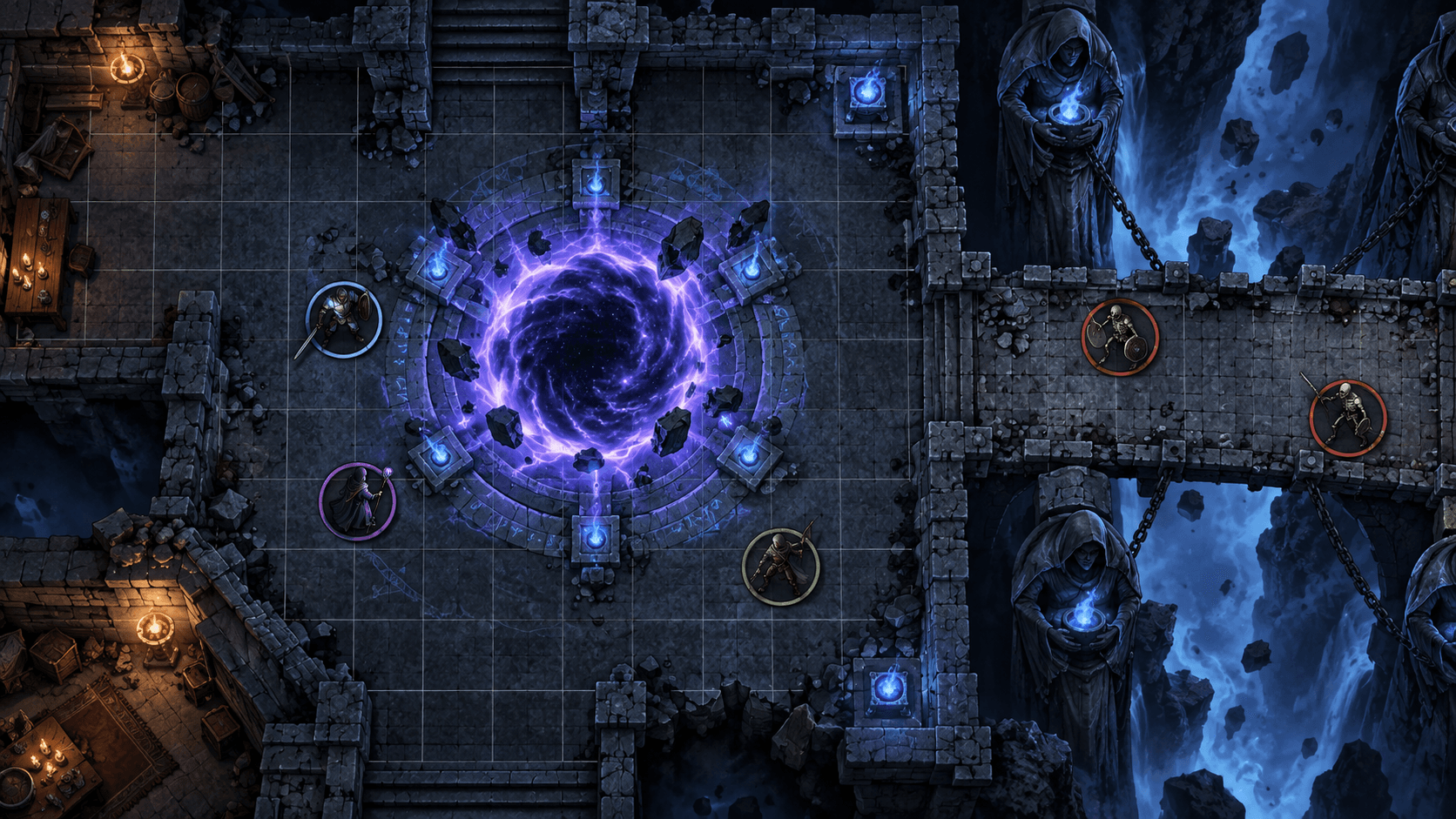
AI is valuable when the prompt contains a constraint that stock generators do not understand: a flooded dwarven elevator, a circular observatory with three bridges, or a dungeon in the visual style of an existing campaign. It is unreliable at exact counts, readable text, doors that actually connect, and consistent grid geometry.
The safe workflow is to use AI for the visual concept, then validate the gameplay layer in an editor. Sprixen's battle map generator is built for that first pass, and the map builder is where you can assemble tiles and export a map. Count the squares yourself. If a corridor needs to be five feet wide, do not accept “it looks five feet wide” as measurement.
A better hybrid workflow
- Generate a dungeon structure with Donjon or a random table.
- Sketch the playable geometry in Dungeon Scrawl or your VTT.
- Use AI or a content library for the visual treatment and important props.
- Overlay the grid and verify movement, doors, cover and line of sight.
- Keep a clean player version without secret labels and a GM version with notes.
How to choose in 30 seconds
- Need a dungeon right now: Donjon.
- Need a dungeon you can edit during a campaign: Dungeon Scrawl.
- Need a polished room with furniture and lighting: Dungeon Alchemist.
- Need a setting nobody has a stock pack for: AI-assisted generation plus manual validation.
- Need only story prompts: random tables.
A free tool is not free if it creates an hour of repair during the session. The best generator gives you the right kind of control for the next step, whether that next step is improvising a room, moving a wall, or exporting a scene players can actually measure.
Ready to try Sprixen?
Generate consistent, style-locked sprites for your game. 6 free credits on signup, no credit card required.
Get Started FreeRelated Articles
7 Best D&D Map Makers in 2026 (Battle Maps and Dungeons Compared)
Dungeon Alchemist, Inkarnate, Dungeondraft, Dungeon Scrawl, Wonderdraft, Arkenforge and Sprixen's free battle map generator compared on price, map type, VTT export and learning curve.
The Best Animated Battle Map Tools in 2026: A Practical Comparison
Animated maps are useful when motion communicates gameplay. Here is how Foundry, Roll20, Owlbear, Czepeku, Dungeon Alchemist and Sprixen compare on format, setup and table performance.
How to Import the Same Battle Map into Roll20, Foundry and Owlbear Rodeo
A VTT-neutral workflow for sizing, aligning and testing one battle map across Roll20, Foundry VTT and Owlbear Rodeo without rebuilding the art three times.