Make All of Your Game's Art with Claude Code in One Style
How to have Claude Code (or Codex) generate every asset of a game in one consistent style through MCP: project setup, the exact prompts, icon and UI packs, animations, limits, timings and costs from a real run.
The people who get the most out of AI game art in 2026 do not open an image generator. They tell their coding agent to make the game, and the agent generates the art as it goes: the hero, then enemies, then items, the HUD, tiles and effects. The hard part is keeping all of it in one style across dozens of requests. This is how we set it up, and what a real run produced.
1. Connect Sprixen to the agent
claude mcp add --transport http sprixen https://api.sprixen.com/v1/mcpRun /mcp in Claude Code, pick sprixen and sign in; add --scope user to use it in every project. Codex uses codex mcp add and codex mcp login (see connecting Codex).
2. One project per game
Style lives on the project: art style, resolution, view angle and palette. The agent creates it once and passes its ID to every generation. Our run started with:
Create a Sprixen project "Ember Hollow": pixel art, 64x64, top-down,
for a cozy autumn forest action RPG. Use it for every asset in this game.
Put the project ID in your CLAUDE.md or AGENTS.md so a new session keeps using it:
## Art
- All art comes from Sprixen project cmv... (pixel art, 64x64, top-down).
- Use packs (up to 8 items) for icons and HUD pieces.
- Save files under assets/sprites/, assets/icons/, assets/ui/.
- Never resize pixel art by a non-integer factor.
3. The requests
These went out in the same minute:
| Asset | Request | Credits | Time |
|---|---|---|---|
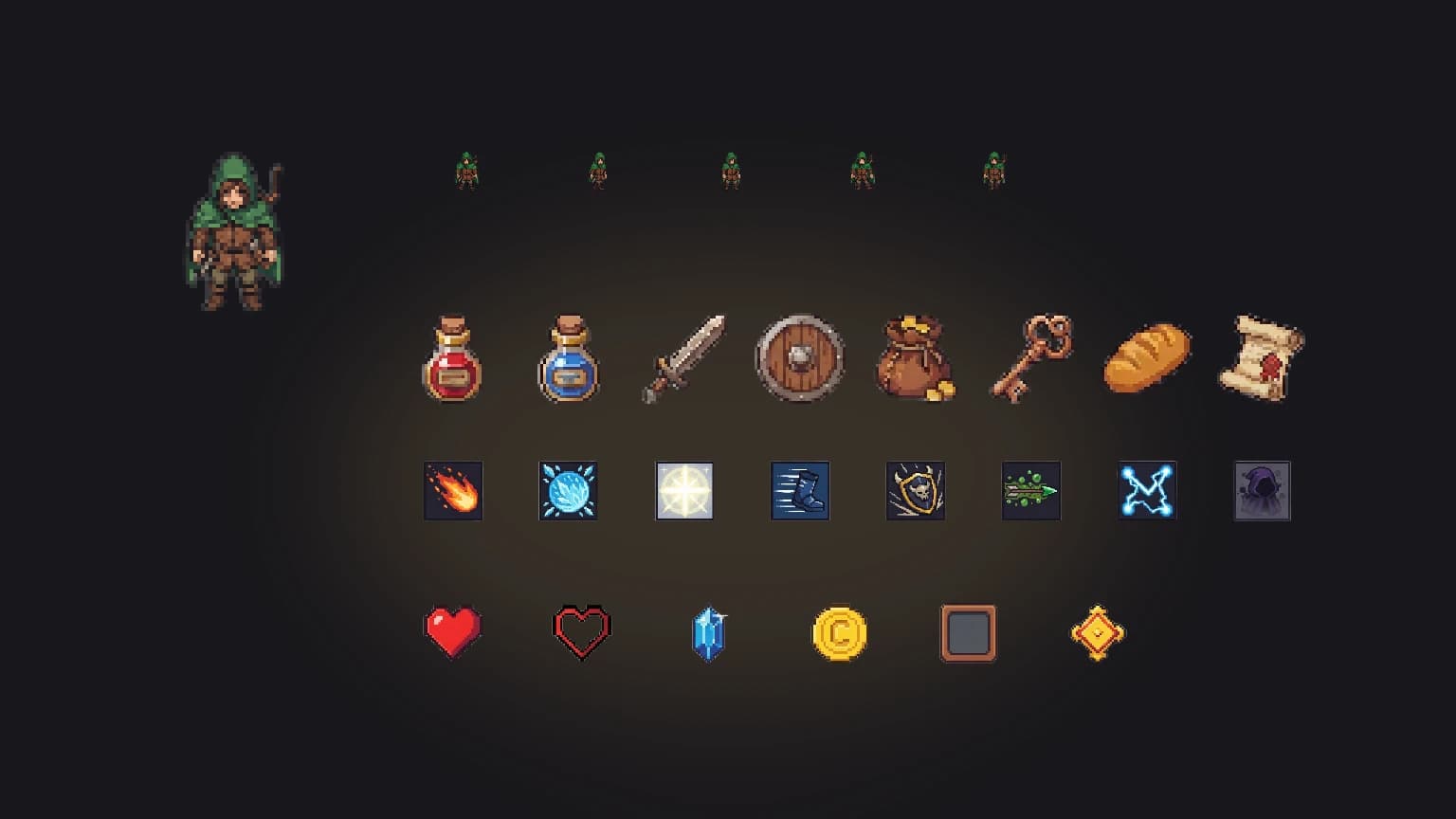
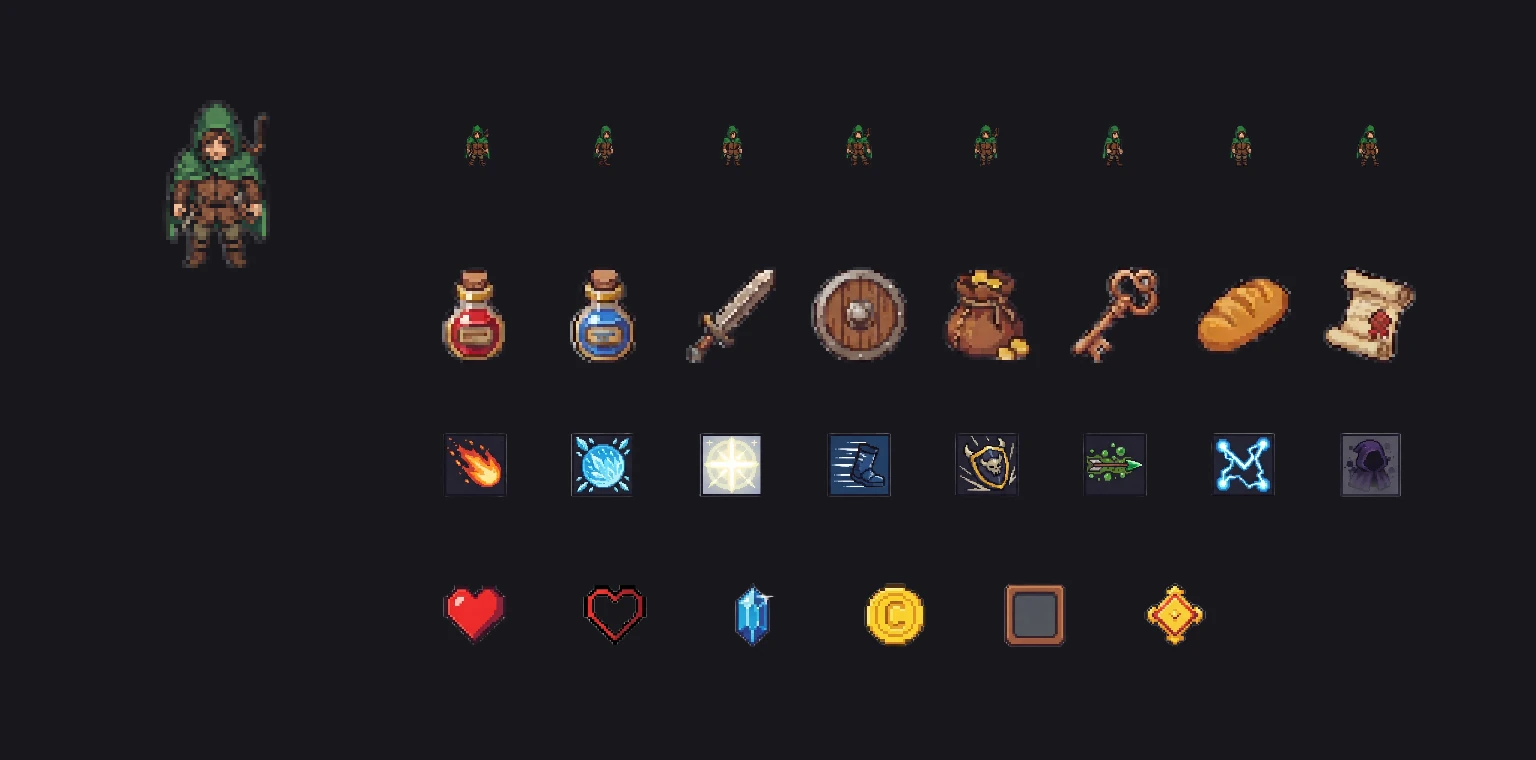
| Hero | Young ranger with a green hood, brown leather tunic, short bow on the back | 2 | 30 s |
| Walk, 4 directions | Chained to the hero: down, up, left, right | 16 | about 10 min, in parallel |
| Inventory icons, 32x32 | Pack: potions, sword, shield, coin pouch, key, bread, scroll | 2 | 25 to 42 s |
| Ability icons, 64x64 | Pack: fireball, frost nova, heal, dash, shield bash, poison arrow, chain lightning, stealth | 2 | 66 s |
| HUD pieces, 64x64 | Pack: hearts, mana crystal, coin, slot frame, quest marker | 2 | 42 to 99 s |
24 credits for a hero, four walk cycles and 22 icons and UI pieces, all sharing the palette and outline of the hero. Packs are the key to the price: eight icons cost the same as one sprite.
4. What the agent has to handle
- Polling. Every generation returns an ID and a suggested wait; the agent calls
get_generationuntil it is done. Animations take minutes, so let the agent keep coding meanwhile. - Concurrency. A few jobs can run at once per account. Past that, the server answers "too many active jobs" with a retry time, and the agent waits and retries. Our run hit it on the fifth parallel request.
- Checking results. Ask the agent to look at each sheet before using it. In our run, one walk direction had two frames facing the wrong way, and the first HUD pack came back with gray cards behind the pieces; both were caught by looking and fixed by regenerating.
- Saving to the repo. Results are URLs; have the agent download them into your assets folders with stable names.
5. Into the engine
For characters, ask for an engine package: export_character_package with godot, unity, gamemaker, phaser or rpgmaker-mz returns a ZIP with sliced sheets, an atlas, a manifest with fps and pivot, and engine import files. An agent with an engine MCP server installed can then add the character to the scene itself; see the best MCP servers for game development.
6. The prompts that kept the style
- Name the game's setting once in the project description; keep individual prompts about the object.
- Ask for families as packs (all potions together, all skills together) so they share lighting.
- Give a size override per family instead of resizing later (32x32 items, 64x64 skills).
- For characters that need 8 directions, render them from 3D in Character Studio so every direction is the same model.
FAQ
Can Claude Code generate game art?
Yes, through an MCP server. With Sprixen connected, Claude Code can create sprites, icon and UI packs, animations, tiles, music and 3D models, and export characters for Godot, Unity, GameMaker, Phaser or RPG Maker MZ.
How do I keep AI game art consistent across many prompts?
Lock the style on a project (art style, resolution, view angle, palette), generate every asset into that project, and request related items as packs so they share lighting and outlines.
How much does it cost to make a game's art this way?
In our run, a hero with four walk cycles and 22 icons and HUD pieces cost 24 credits. The Pro plan is $10 a month for 200 credits, and new accounts start with 6 free credits.
Wire Sprixen into your agent.
The Sprixen MCP server lets Claude Code, Cursor and other agents generate sprites, animations, 3D models and VFX without leaving the chat.
Related Articles
Best MCP Servers for Game Development in 2026 (Godot, Unity, Unreal, Blender, Roblox)
The MCP servers that let Claude Code, Codex and Cursor work inside game engines and generate game assets: Godot, Unity, Unreal, Blender, Roblox Studio, Aseprite and asset generators, with stars and install commands.
How to Connect Sprixen to Codex with OAuth (No API Key)
Connect the Sprixen MCP server to the Codex CLI, app or IDE extension in two commands with OAuth sign-in, then generate sprites, icons and animations for your game from Codex.
How to Mod Games with AI Agents: A 2026 Guide for Claude Code and Codex
How to mod games with AI agents in 2026: what changed, the universal-modder workflow in Claude Code, art that matches the original game, and the legal lines to respect.