
Top-Down Sprite Sheets: 4 vs 8 Directions, Sizes and Frame Counts
When a top-down game needs 4 or 8 directions, how many frames that means, which directions can be mirrored, and how 2D drawn and 3D rendered sprite sheets compare in a real test.
A side-view character needs one facing and a flip. A top-down or isometric character needs to face where it walks, which multiplies every animation by four or eight. That choice drives most of your art budget, so make it on purpose.
4 or 8 directions?
| 4 directions | 8 directions | |
|---|---|---|
| Facings | Down, left, right, up | Plus the four diagonals |
| Unique to draw with mirroring | 3 (draw left, mirror for right) | 5 (mirror the left side to get the right side) |
| Frames for walk, idle and attack at 8 frames | 96 (72 unique) | 192 (120 unique) |
| Fits | Grid movement, Zelda-likes, farming games, most RPG Maker style games | Free 360 movement, twin-stick shooters, ARPGs, isometric games |
Four directions read fine with grid or keyboard movement. With analog sticks or mouse aiming, a character that snaps between four facings looks stiff when it walks diagonally, and eight becomes worth the cost.
Mirroring saves a lot, with one catch
Flipping the left-facing art horizontally gives the right-facing art for free. The catch is anything asymmetric: a sword in the right hand switches hands, a scar switches cheeks, a shoulder pad changes side. If your character carries a weapon, either accept the swap (most players never notice at 32 px) or draw both sides.
Sizes and frame counts
- Sprite size: 16x16 to 32x32 for retro and farming games, 48x48 to 64x64 for action RPGs, 96 px and up for detailed characters.
- Walk: 4 to 8 frames at 8 to 12 frames per second.
- Idle: 2 to 4 frames, or a gentle 6 to 8 frame breathing loop.
- Attack: 4 to 6 frames with a clear hit frame.
- One shared cell size and pivot for every animation, so the character never jumps when switching.
Test: 4 directions drawn in 2D
We generated a 64x64 hooded ranger in a top-down pixel art project and chained a walk for each of the four directions: 18 credits, about 10 minutes, the four walks running in parallel.
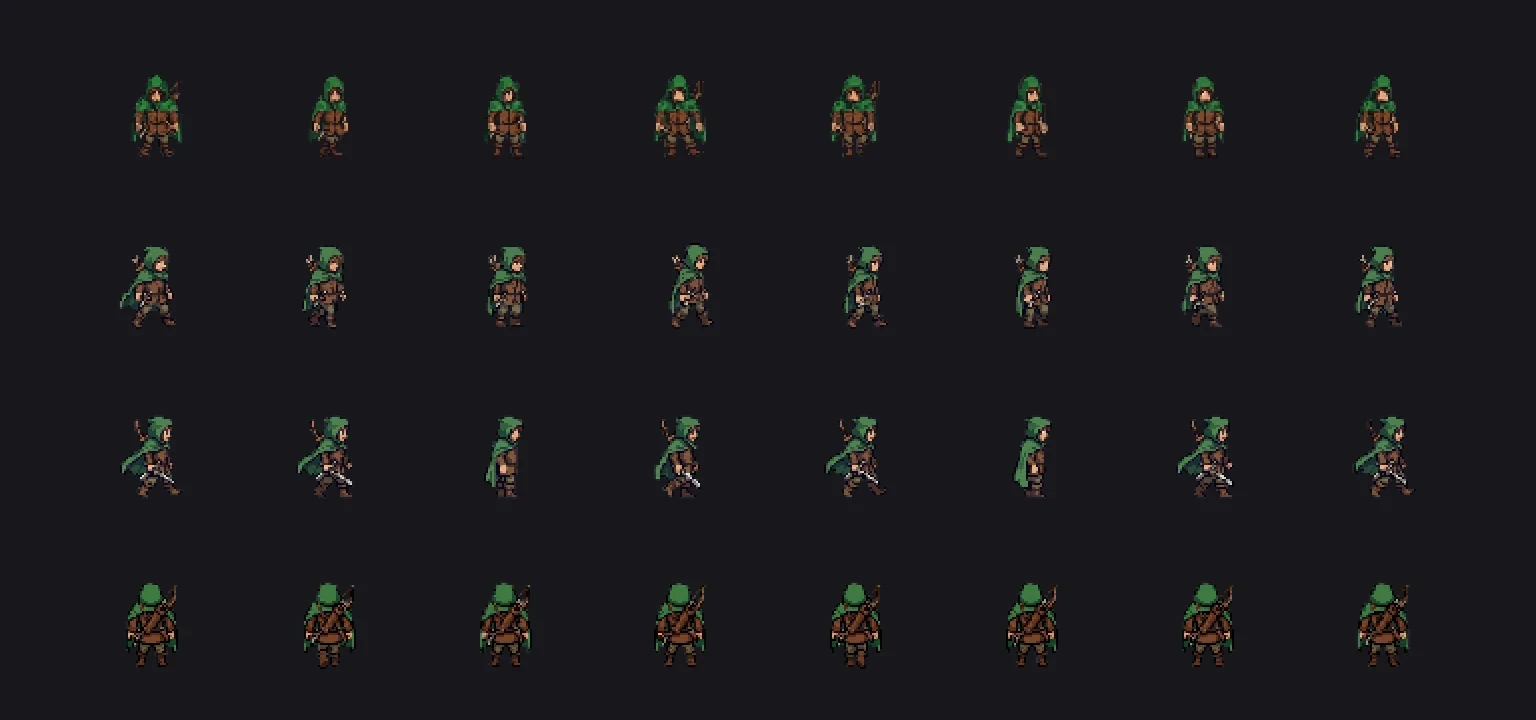
The art is consistent in style, and down, left and up work. The right-facing row shows why drawn directions need a check: two frames face the wrong way, and the bow became a blade. Regenerating that one row fixes it; the point is to look at every row before wiring it into the game.
Test: 8 directions rendered from 3D
The same idea through Character Studio: a rigged low-poly base customized from one sentence, then the walk rendered from 8 camera angles. Customizing cost 2 credits and took 2 minutes; the 8-direction walk at 64 px cost 4 credits and took 29 seconds.
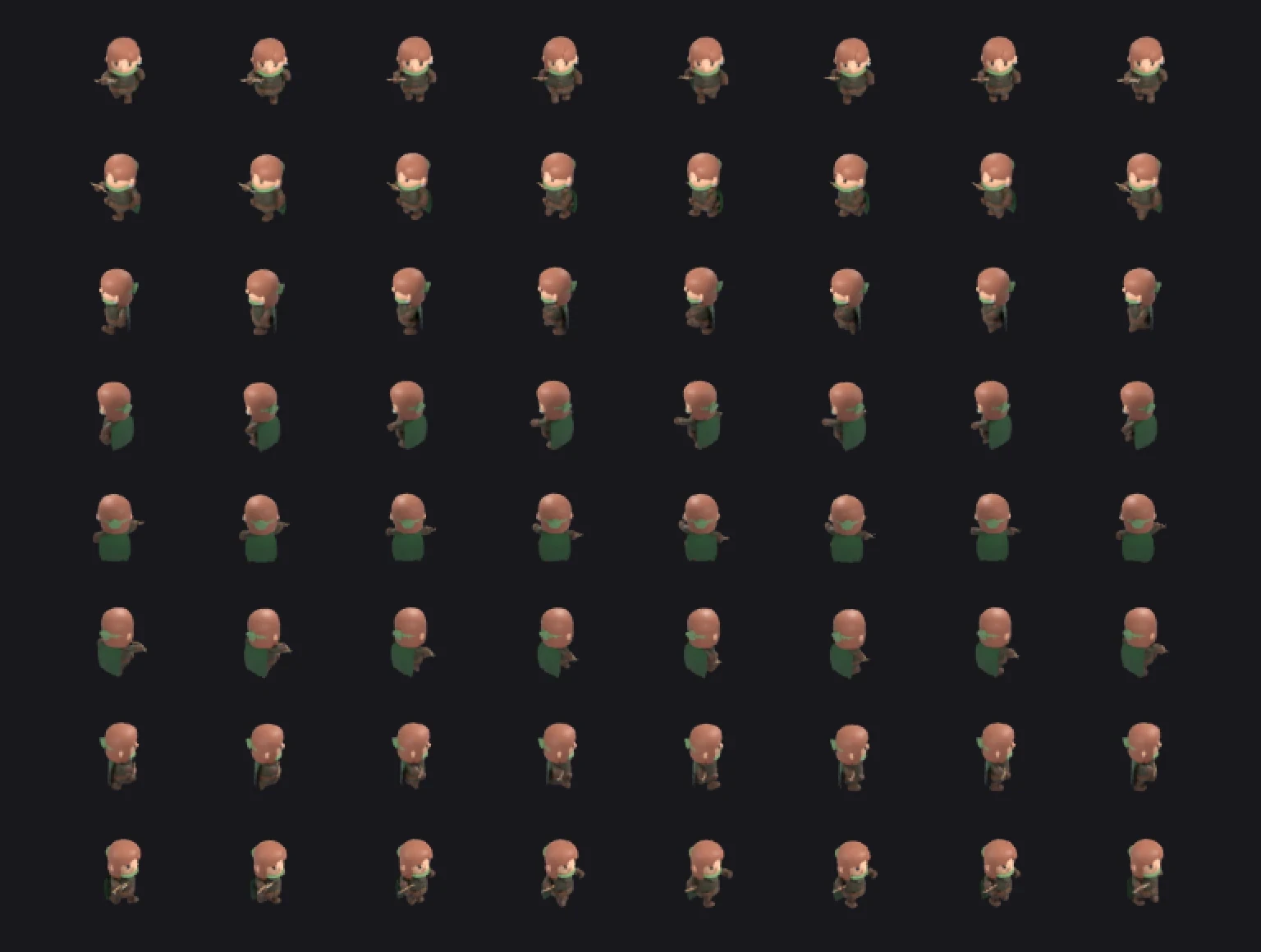
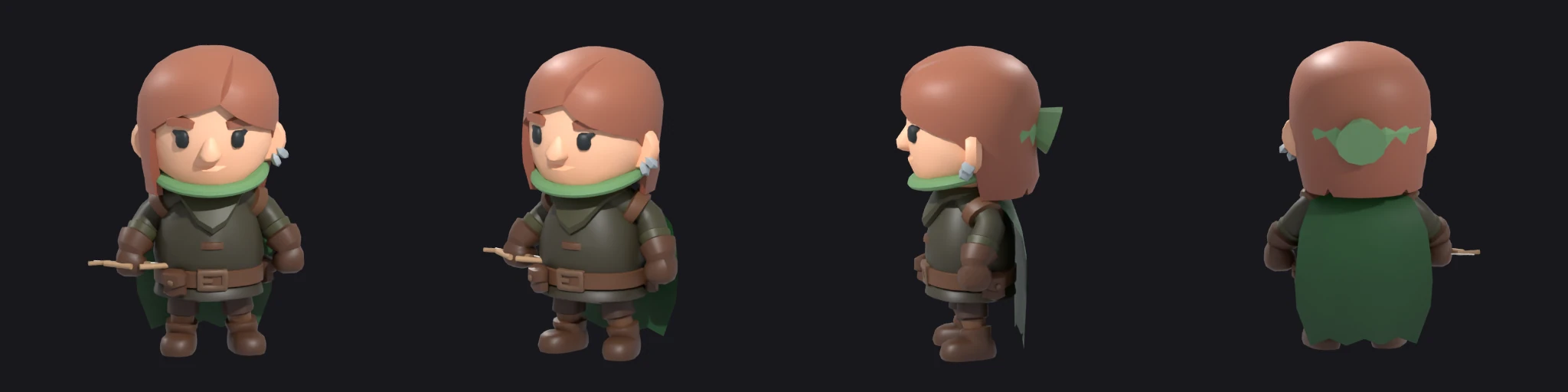
Every direction is the same character at the same scale, and switching to run, attack or death is another 4 credits for all eight directions. Two limits showed up: the look is a stylized low-poly figure rather than hand-drawn pixel art, and parts the base does not have get built from simple shapes (the hood we asked for came out as a green collar).
Which route to take
- Pixel art with a hand-drawn look, 4 directions: draw or generate in 2D, mirror left and right, check each row.
- 8 directions with many animations: render from 3D. The cost per animation is flat for all eight directions and the character cannot drift.
- Isometric games: use the 8-direction route, since the camera already sits at an angle; set the camera elevation to match your tiles (about 30 degrees for a 2:1 grid).
To try the 3D route, open Character Studio. For the tools that animate in 2D, see our comparison of AI sprite animation generators.
FAQ
Do top-down games need 8 directions?
No. Grid-based and keyboard-driven games usually look fine with 4 directions. Games with analog or mouse movement in any direction benefit from 8.
Can I mirror sprites to save time?
Yes. Mirroring the left-facing frames gives the right-facing ones, which cuts 8 directions to 5 unique facings. Asymmetric details such as a weapon hand will swap sides.
How many frames is a top-down walk cycle?
Four to eight frames per direction at 8 to 12 frames per second. Eight frames give a smoother stride; four are common at 16x16 and 32x32.
How do I keep a character consistent in every direction?
Generate every direction from the same reference sprite and check each row, or render the sprite sheet from one 3D model so all directions share the same geometry.
Generate sprites that actually match.
Style-locked sprite generation keeps every character, tile and animation in your project visually consistent. 6 free credits on signup, no credit card required.
Related Articles
Best AI Sprite Animation Generators in 2026 (Walk Cycles, Attacks, 8 Directions)
AI sprite animation generators compared: how each one animates (text, image, skeleton, video, 3D), frame counts, directions, export formats and price per animation, plus a real 4 and 8 direction test.
AI Sprite Generator for Unity: From Prompt to Animated Sprite in One Import
Generate pixel art sprites and walk cycles with AI and import them into Unity as a sliced sprite sheet with pivots and animation clips: package contents, import settings and a player script.
AI Sprite Generator for GameMaker: Strips, Origins and Animation Speed
Generate pixel art sprites and walk cycles with AI and bring them into GameMaker as auto-sliced strip images, with the right origin, playback speed and a four-direction movement script in GML.